The parking lot is the hardest part. Ask almost anyone who has been to an Alcoholics Anonymous meeting and they will tell you the same thing: the few minutes spent sitting in the car, engine off, deciding whether to go inside, felt longer than the meeting itself. This article is meant to shorten those minutes. Below is a straightforward, step-by-step account of what usually happens at a first AA meeting, how meetings differ, and where women in Miami-Dade and Broward County can find one tonight.
A quick primer on Alcoholics Anonymous
Alcoholics Anonymous began in Akron, Ohio, in 1935, when two men struggling with alcohol discovered that talking honestly with one another helped both of them stay sober. Nearly a century later, A.A. describes itself as a worldwide fellowship of people who share their experience, strength and hope so they can solve their common problem and help others recover. There are no dues or fees, no sign-up sheet and no professional staff running the room. Each group is self-supporting through its own members’ contributions.
The only requirement for membership is a desire to stop drinking. You do not have to be sure you are an alcoholic. You do not have to be sober that day. You do not have to say a word. The official Alcoholics Anonymous website explains the basics and is a good place to read more before you go.
Before you go: three decisions to make
A little planning takes the edge off.
- Pick an “open” meeting if you are unsure. Open meetings welcome anyone, including people who are just curious or are supporting someone else. Closed meetings are reserved for people who have a desire to stop drinking. If you are here for yourself, either is fine.
- Consider a women’s meeting. Many groups hold meetings specifically for women. For a first visit, a women’s meeting can feel quieter and more familiar. Women’s AA meetings are listed separately in most local directories.
- Arrive ten minutes early. Early arrival gives you time to find the room, grab a coffee and, if you like, tell one person you are new. Someone will almost always offer to sit with you.

Most meetings start with a cup of coffee · Photo: Roman Kraft on Unsplash
What happens in the room, step by step
Formats vary from group to group, but most first-timers in South Florida will see something close to this sequence.
The opening
A volunteer chairperson opens the meeting, often with a moment of silence followed by the Serenity Prayer. Someone reads the A.A. Preamble, a short statement describing what the fellowship is and is not, and sometimes a passage from the book Alcoholics Anonymous — known to members as the Big Book. You may also hear the Twelve Steps or the Twelve Traditions read aloud.
Introductions and newcomers
The chair may ask whether anyone is attending for the first time or is new to the area. You are welcome to raise your hand and say your first name — or not. Raising your hand usually means a few people will speak to you afterwards and offer phone numbers. That is not pressure; it is how the fellowship takes care of newcomers.
The main portion
Depending on the type of meeting, this is a single speaker sharing her story, a reading followed by discussion, or a topic that members take turns responding to. When people share, they typically introduce themselves by first name — “I’m Maria, and I’m an alcoholic” — and the room answers with a hello. If you are called on and do not want to speak, you can simply say “I’ll pass” or “I’m just listening tonight.” No one will mind.
The basket
Partway through, a basket is passed. This is the group’s Seventh Tradition: members contribute a dollar or two toward rent, coffee and literature. Newcomers are often encouraged not to give anything at their first meetings. If you prefer to contribute, a small amount is plenty.
Chips and the close
Many groups give out small tokens — often called chips or coins — to mark sobriety milestones such as 24 hours, 30 days or 90 days. Customs vary; some groups give a desire chip to anyone who wants to try sobriety starting today. The meeting usually ends with members standing together for a short prayer or statement. Join in or simply stand quietly. Both are normal.
The different kinds of AA meetings
If the first meeting did not feel like a fit, the format may be the reason, not the fellowship. Common formats include:
- Speaker meetings: one or two members tell their story at length — what it was like, what happened and what it is like now. Good for listening without pressure.
- Discussion meetings: a topic is chosen and members share briefly in turn.
- Big Book study: the group reads a section aloud and discusses it.
- Step study: the group focuses on one of the Twelve Steps at a time.
- Women’s and men’s meetings: meetings limited to one gender, which many people find easier for personal topics.
- Online and hybrid meetings: useful when transportation, health or work hours make in-person meetings hard.
The general rule of thumb is to try at least several different meetings before deciding whether AA is helpful for you. Like restaurants or churches, each group has its own personality.

Women’s meetings can feel quieter and more familiar · Photo: Jametlene Reskp on Unsplash
“90 meetings in 90 days” — what it means
Newcomers often hear the suggestion to attend 90 meetings in 90 days. It is not a rule and nobody checks attendance. The idea is simply that early sobriety is fragile, and a daily meeting gives each day a fixed anchor point — a place to be, people who expect you, and an hour in which drinking is not an option.
For women in early recovery, 90 in 90 can also be a fast way to learn who is who in the local recovery community, find home groups and meet a potential sponsor. If daily attendance is not realistic because of work or family obligations, the spirit of the suggestion still applies: make meetings a regular, non-negotiable part of the week. Our article on building healthy routines in early recovery has more ideas for structuring those first months.
How to find AA meetings in Miami-Dade and Broward County
Miami sits in the middle of one of the most active recovery communities in Florida, with meetings running from early morning to late evening every day of the week. A few reliable ways to find one:
- Miami-Dade AA. The local service office keeps a Miami-Dade AA meeting directory, with in-person, online, English and Spanish meetings across Miami, North Miami and Miami Beach.
- Broward County Intergroup. The local AA service office maintains a searchable meeting directory for Broward County, including Hollywood, Dania Beach, Hallandale Beach, Pembroke Pines and Fort Lauderdale.
- The Meeting Guide app. A.A.’s free app pulls listings from local service offices. Its help page explains how to find an A.A. meeting near you and filter for women’s, open or online meetings.
- Ask in the room. Once you are at one meeting, someone will happily tell you about five more.
Because meeting times and locations change, always confirm a listing on the day you plan to go.
Miami, Florida — meetings run across Miami-Dade and Broward every day · Open in Google Maps
What first-timers often worry about
“Will someone I know see me?”
Possibly. But they are there for the same reason you are. Anonymity is one of A.A.’s founding principles: who you see there, and what you hear there, stays there.
“Is it religious?”
A.A. talks about a “higher power” and some meetings close with a prayer, but the fellowship is not affiliated with any religion. Members include people of many faiths and none. Many newcomers define a higher power in their own way, or simply use the group itself.
“What if I’m not sure I’m an alcoholic?”
You do not need to decide that to attend. Many people go to an open meeting simply to listen and see whether the stories sound familiar. If you are weighing your options, the NIAAA’s overview of mutual support groups describes A.A. alongside other approaches.
“What if I relapse?”
Then you come back. Meetings are full of people who have started over. The door does not close.

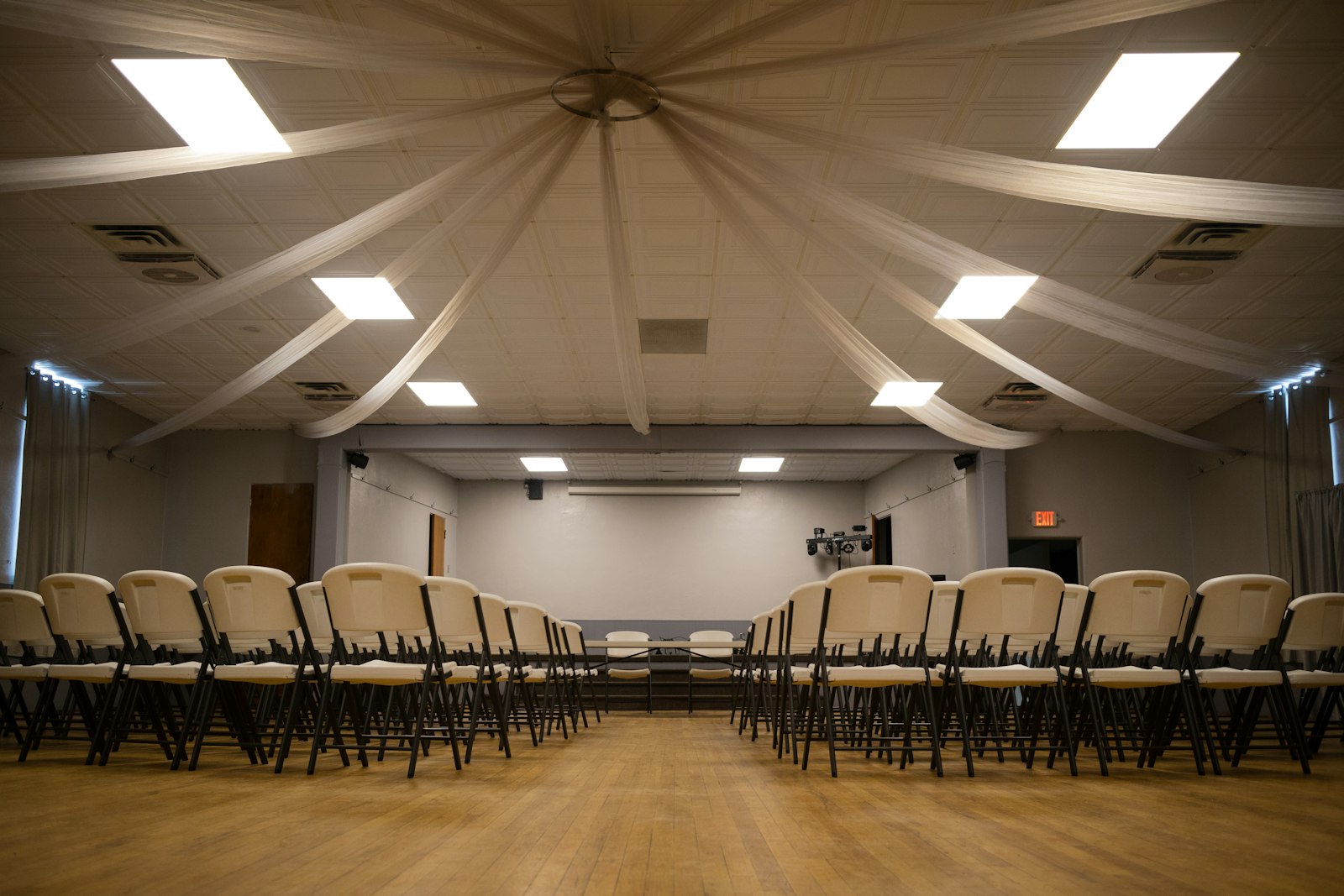
Every chair is a seat somebody saved for a newcomer · Photo: Richard Heinen on Unsplash
After the meeting: the part that matters most
Experienced members often say the real meeting happens in the parking lot afterwards. That is where phone numbers are swapped, coffee plans are made and newcomers are invited to the next meeting. If you can, stay ten minutes. Ask one person which other meetings she likes. Put two or three numbers in your phone, even if you are certain you will never call them. You may surprise yourself.
Over time, one of those numbers might belong to your sponsor. If you are wondering what that relationship involves, read our companion guide, What Does an AA Sponsor Do?
How sober living supports meeting attendance
Going to meetings is easier when the rest of your life is steady. That is one of the reasons many women choose to spend the months after treatment in a structured, substance-free residence. In a good women’s sober living home, evening meetings fit naturally into the day, housemates often go together, and there is someone to talk to on the drive home.
If you are comparing options, our guide to sober living versus treatment explains how the two fit together, and our FAQ answers common practical questions.

The door stays open · Photo: Peter Herrmann on Unsplash
Take the first step
You do not need to have it all figured out to walk into a meeting. You only need to walk in. If you would like support around that first step — or a calm, women-only home to come back to afterwards — call Recover at Monarch at (949) 438-8568 or begin your journey here.
This article is general education, not medical or clinical advice. Everyone’s recovery is different — please speak with a qualified healthcare provider about your own situation. Alcoholics Anonymous is an independent fellowship; Recover at Monarch is not affiliated with or endorsed by A.A. If you or someone you love is in immediate danger, call 911. For crisis support, call or text 988. SAMHSA’s National Helpline is free, confidential and available 24/7 at 1-800-662-4357.